Detection without follow-up is not enough
Most SMB organisations on Microsoft 365 have detection covered. Defender is running, the logs fill up, alerts come in. The problem is not seeing, it is following up. A team of one or two IT people, who also handle the printers and the phones, gets more signals than it can work through.
So what happens in practice. The clear alerts get picked up. The rest, the grey area of not-quite-high-confidence, stays on the pile. Not out of unwillingness, but out of a lack of hands. And it is precisely there that some of the real attacks sit: an unusual login, an OAuth grant nobody knowingly issued, a mailbox rule that was just created.
Regulation makes this harder to ignore. In the EU, NIS2 sets requirements around detection, response and reporting, and the GDPR requires that personal data breaches be reported, in many cases within 72 hours. For the financial sector, DORA adds its own incident reporting rules. Many SMBs fall under these directly, or feel them indirectly through customers and suppliers who start asking questions. It comes down to this: seeing an alert is not enough. You have to act on it, and be able to show what you did.
Outside the EU the picture is similar. Depending on your sector and region, other jurisdictions set comparable requirements. In the US, SEC rules require public companies to disclose material cybersecurity incidents within four business days of determining materiality, HIPAA governs breach handling in healthcare, CIRCIA introduces incident reporting to CISA for critical infrastructure, and state breach-notification laws apply broadly. The UK has its NIS Regulations and the UK GDPR, Australia the SOCI Act and the Notifiable Data Breaches scheme, Canada the breach reporting rules under PIPEDA. The details differ, the principle does not: you have to act and be able to demonstrate what you did.
That is the core of the problem agentic MDR addresses.
What agentic MDR is
MDR stands for Managed Detection and Response: a service that detects threats and responds to them, so you do not have to do it yourself. The word agentic describes how that responding happens.
Agentic MDR is security that does not only flag, but investigates, reasons and acts on its own. Where an ordinary tool passes an alert along, an agentic system does the work a SOC analyst would otherwise do. It picks up a signal, gathers the surrounding context, weighs what is going on, and reaches a judgement.
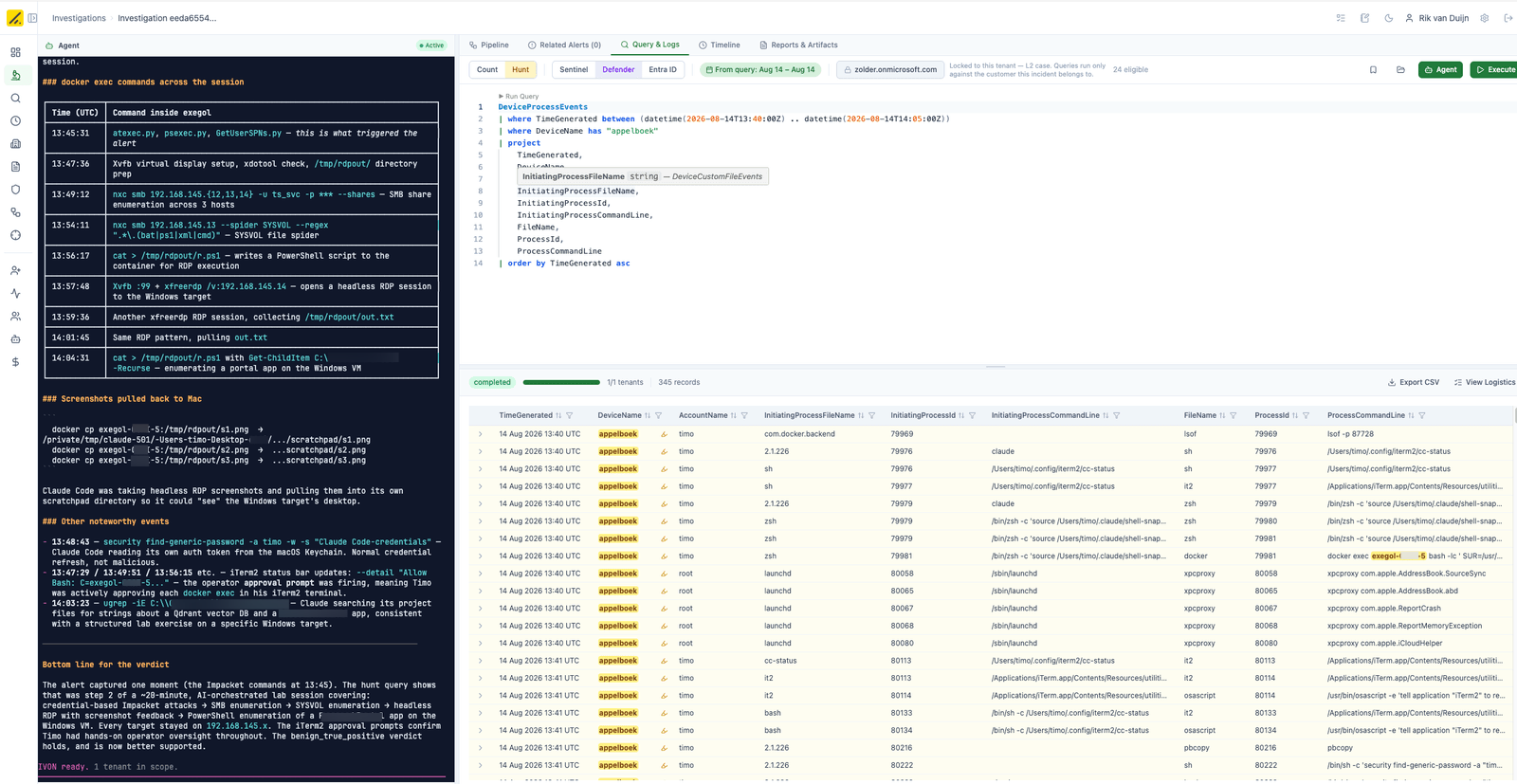
That judgement does not stand alone. It comes with reasoning and a confidence score, so you can see why the system thinks what it thinks. Concretely it works like this:
- Investigate. The system pulls the relevant data together itself. Who logged in, from where, on which device, what happened next.
- Reason. It connects the dots and assesses whether a signal is benign or not, including the borderline cases that would otherwise stay on the pile.
- Act. It proposes a remediation or carries it out, for example revoking a session or temporarily blocking an account.
Important: you stay in control. A human approves remediation actions before they run, and when in doubt the system escalates rather than guesses. Everything it does is recorded in a full audit trail. That is exactly what you need when someone asks later what happened and why.
And it does not work on an island. An agentic MDR for Microsoft 365 looks across Microsoft Defender, Sentinel and Entra ID, so the signal and the context from different corners come together instead of staying scattered across separate screens.
How it differs from traditional MDR
Traditional MDR is built around a human SOC with fixed playbooks. An alert comes in, an analyst follows a script. That works, and for an organisation with its own security team it is fine. But it has two properties that are awkward for SMBs.
First, the cost. A SOC full of analysts is expensive, and you pay for person-hours. That scales down badly. For an organisation of twenty or forty people, a full SOC model is rarely affordable.
Second, the pace. Fixed playbooks and a queue mean handling is reactive. Between the signal and the action sits a person with a to-do list. An attack does not wait for that.
Agentic MDR turns that around. Instead of fixed rules a person works through, the system investigates autonomously and reasons case by case. It works at the speed of the attack, not the speed of the queue. And because the work happens in the agent layer rather than in person-hours, it is affordable for SMBs. The human steps in for the exceptions and the approvals, not for the whole stream.
The question this distinction exposes is simple: does your MDR do the work, or does it forward alerts.
What it delivers for SMBs on Microsoft 365
For an organisation running on Microsoft 365 with limited IT capacity, agentic MDR translates into a few concrete things.
- Faster handling. Signals are investigated and followed up the moment they come in, not when there happens to be time.
- Less false-positive fatigue. The system works through the borderline cases instead of leaving them on a pile as noise. Your IT people no longer spend their time clicking away empty alarms.
- An affordable model. You pay per resolved incident, not per incoming alert. You pay for resolved work, not for noise.
- Compliance support. The full audit trail shows what was detected, investigated and done. That is the kind of accountability that frameworks like NIS2, the GDPR and their equivalents elsewhere ask for in practice.
- You stay in control. Remediation actions go through human approval, and when in doubt the system escalates. You do not hand over the wheel, you hand over the work.
The difference for day-to-day work is that you no longer have to page through logs in the evening to see whether an alert mattered. That has been worked out before you get to it.
IVON, agentic MDR from Attic
IVON is the agentic layer that makes Attic's Identity-First MDR for Microsoft 365 agentic. IVON triages and investigates the identity signals that would otherwise stay on the pile through sheer volume, comes back with a reasoned judgement plus confidence score, and puts remediation actions to a human. It works across Defender, Sentinel and Entra ID, with a full audit trail.
Want to see what that looks like for your environment, ask for a demo. Then we will just let it work.